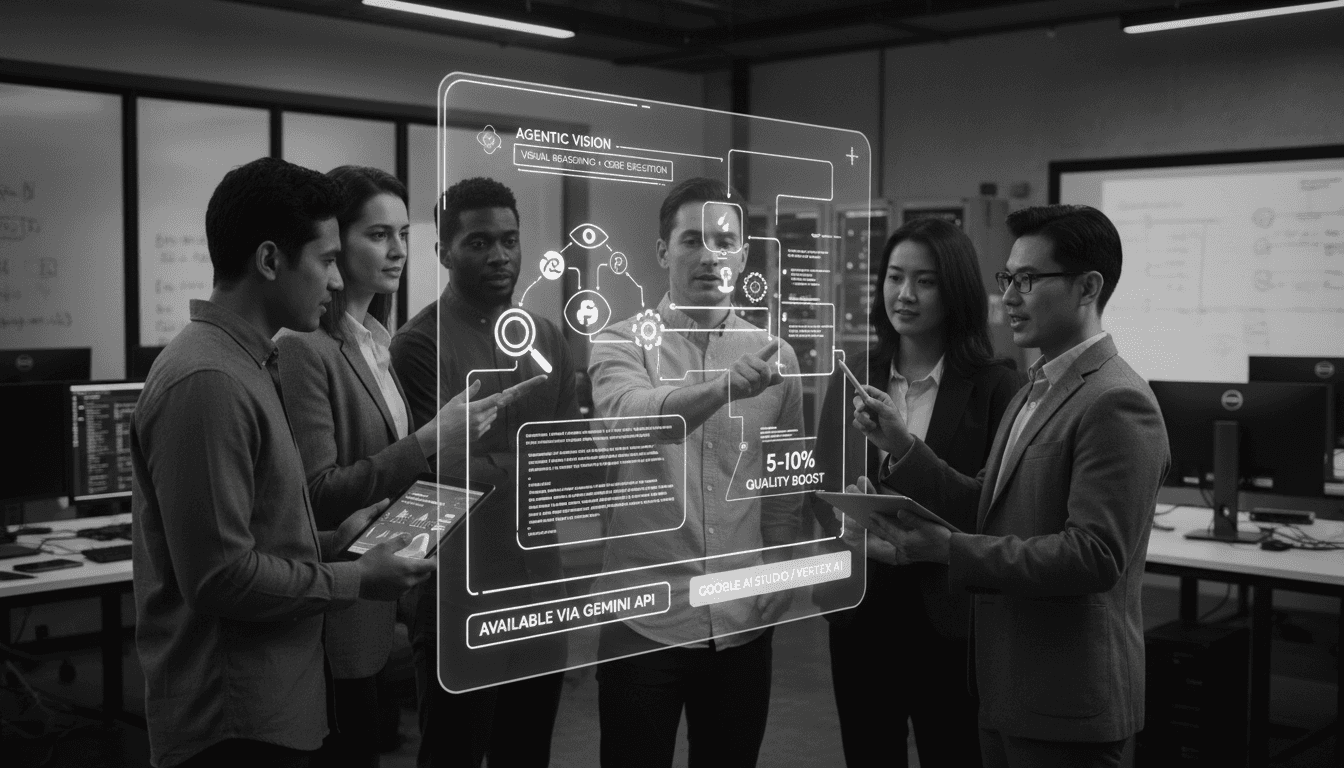
Google introduces Agentic Vision in Gemini 3 Flash to combine visual reasoning and code execution for more accurate, evidence‑grounded image understanding.
• Agentic Vision added to Gemini 3 Flash combines visual reasoning and Python code execution • Google reports a consistent 5–10% quality boost across vision benchmarks • Available via Gemini API in Google AI Studio and Vertex AI; rolling out in Gemini app
Developer/enterprise perspective: Sees Agentic Vision as a practical tool to improve accuracy for real‑world image tasks (e.g., plan validation, counting, charting) and as a capability that can be integrated via APIs and cloud platforms. Product/engineering perspective: Views the think‑act‑observe loop and code execution as an advancement that reduces hallucinations by producing deterministic computations and visual scratchpads, and as a step toward more tool‑enabled, agentic models. Critical/operational perspective: Notes reliance on executed tooling and rollout scope — benefits depend on API access, integration work, and how Google governs tool use and safety; some stakeholders may seek more detail on limits, privacy, and misuse mitigation.
Google announced Agentic Vision as a new capability in Gemini 3 Flash that pairs visual reasoning with runtime code execution so the model can “think, act, observe” when answering image prompts; the approach lets the model generate and run Python to crop, zoom, annotate, compute and visualize image data, and Google says enabling code execution yields a consistent 5–10% quality boost across most vision benchmarks. [2][1][3] The rollout is targeted at developers and enterprises: Agentic Vision is available via the Gemini API in Google AI Studio and Vertex AI and is beginning to appear in the Gemini app’s Thinking model, with early third‑party examples (e.g., PlanCheckSolver) reporting measurable accuracy improvements for tasks such as building plan validation. The capability reframes image understanding from a single static glance to an iterative investigation — using generated code to create new image crops or annotated canvases that are appended back into the model’s context so subsequent reasoning is grounded in pixel‑level evidence. Google also describes plans to expand implicit behaviors, add more tools (web and reverse image search, etc.), and extend Agentic Vision beyond the Flash model size. [2][1][5][4] Implications include stronger grounding for multimodal reasoning and new developer use cases that reduce common vision failure modes (for example, visual arithmetic hallucinations) by offloading deterministic computation to executed code; at the same time, the approach concentrates capability around runtime tool access and model tooling, meaning adoption and effects will depend on API availability, developer integration, and Google’s future tool‑and‑safety choices. Observers see this as another step in making models interactive and verifiable for production image tasks, while Google frames it as an incremental but measurable quality improvement in vision tasks. [2][3][5]