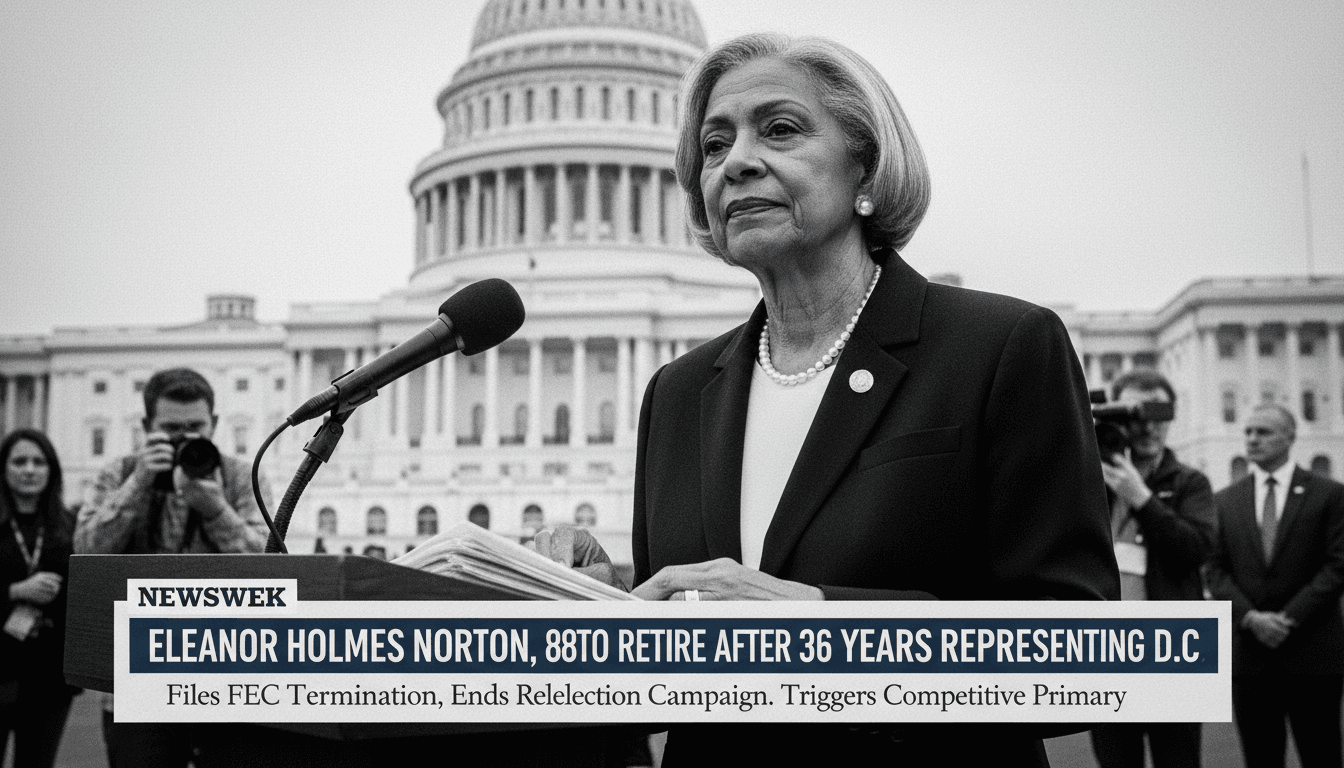
Longtime D.C. delegate Eleanor Holmes Norton filed to end her reelection campaign and will retire at the end of her current term.
• Norton filed a termination report with the FEC that ends her reelection campaign. • She is 88 and has served as D.C.’s nonvoting House delegate since the early 1990s. • Her retirement triggers a competitive Democratic primary in the heavily Democratic district.
Supporters and local leaders frame Norton’s retirement as the end of a storied career: a civil‑rights veteran and a persistent advocate for D.C. statehood and residents’ rights who used committee work and bipartisan deals to advance the district. Critics and some residents argued in recent months that Norton’s age and visibility raised questions about her ability to effectively counter significant federal interventions in the District, and they viewed a leadership transition as necessary to sustain robust advocacy on the Hill. Political analysts note the pragmatic implications: Norton’s departure creates an open, competitive Democratic primary in a seat that will effectively determine the District’s next national voice, and it contributes to a broader wave of retirements reshaping the composition and dynamics of the House.
Eleanor Holmes Norton, the District of Columbia’s long-serving nonvoting House delegate, has filed a termination report with the Federal Election Commission that ends her campaign for reelection and signals she will leave Congress at the end of her current term; reports identify her as 88 years old and note she has represented D.C. in Congress since the early 1990s. Newsweek reported Norton’s filing and quoted a post attributed to her on X announcing her retirement and reflecting on decades of advocacy for D.C. residents and statehood [1]. Other outlets covering the filing describe the same FEC termination paperwork and contextual details about her age, tenure and status as the House’s oldest member, noting she first took office after the 1990 election and has served multiple decades as a nonvoting delegate [2][3][4]. Her decision comes amid heightened scrutiny of her effectiveness over the past year as the federal government intervened in D.C. governance — moves that included federalizing the local police force, deploying National Guard units and sending federal agents into city neighborhoods — and amid a crowded and well-funded Democratic primary field preparing to compete for the open seat; local leaders including Mayor Muriel Bowser publicly praised Norton’s record even as some residents and officials questioned whether a new generation should take up the fight for D.C. representation [1][3][4]. Coverage also highlights Norton’s legislative achievements and long civil‑rights record — from leadership roles in the Equal Employment Opportunity Commission to championing tuition assistance and fiscal agreements that shaped the District — framing her as an influential advocate despite the limits of a nonvoting delegate’s role [1][4]. Practically, Norton’s exit is expected to produce a competitive Democratic primary in an overwhelmingly Democratic jurisdiction and to add to a larger wave of House retirements; analysts and local politicians emphasize both the symbolic end of an era and the tactical implications for D.C. advocacy and congressional politics. Reporting contains minor discrepancies on headline details — chiefly how many total years she is described as having served — but uniformly places her retirement within the broader story of D.C.’s long campaign for full representation and recent tensions with federal authorities [1][2][3][4].
Controversy
Reporting differs on some specifics: Newsweek describes Norton’s tenure as 36 years and quotes a post on X announcing her retirement [1], while other outlets tied to AP/Reuters reporting refer to her service as 35 years (first elected in 1990 and serving since 1991) or cite different year counts [3][4]. Additionally, some coverage emphasizes a public statement attributed to Norton [1], whereas other reports note her office had not issued an official statement when the termination filing was first reported [2][3].