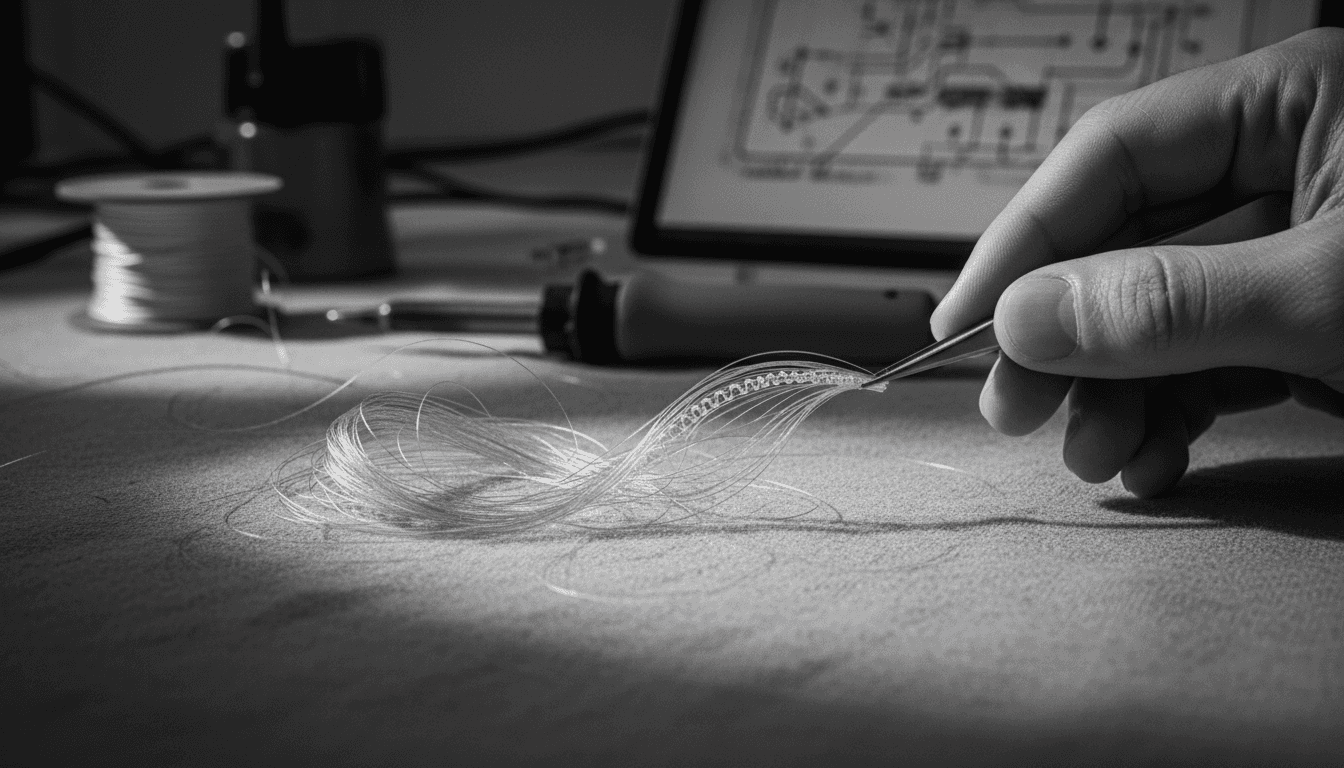
Researchers report two different flexible computing breakthroughs in China: a Fudan 'fiber integrated circuit' thread and separate flexible AI/photonic chips with wearable and medical applications.
• Fudan’s fiber integrated circuit embeds dense circuitry in a 50µm fiber • Another Chinese team reported a thin, low-power flexible AI chip (FLEXI) • Both approaches target wearables, medical implants and tactile interfaces
Technical-optimist: These demonstrations show novel fabrication and integration approaches (spiral FICs and compute-in-memory/photonic chips) that could finally make truly conformable, powerful wearables and soft implants feasible, enabling applications from tactile VR to closed-loop neurological devices. Cautious-engineering: Laboratory durability and extreme-test claims (e.g., truck compression, thousands of bends, washing cycles) are encouraging but require independent replication, standardized metrics and system-level solutions for power, interconnects, latency and maintenance before consumer or clinical use. Ethical/clinical: For medical and brain-interface applications, reviewers and regulators will emphasize biocompatibility, long-term safety, data security and clinical trial evidence; task-specific AI/analog chips also trade general programmability for efficiency, limiting some uses while improving energy and latency performance.
Researchers at Fudan University have demonstrated a “fiber integrated circuit” (FIC) built by printing multilayer circuitry on an elastomer film, rolling it into a spiral, and encapsulating it as a fiber roughly 50 micrometers in diameter (thinner than an average human hair); the team reports integration densities up to 100,000 transistors per centimeter, durability through tens of thousands of bending/abrasion cycles and extreme compression tests, and claims the fabrication method is compatible with existing semiconductor tools — enabling envisioned uses in smart textiles, VR tactile gloves and even brain implants, and prompting collaboration with a hospital on surgical applications [1][3][4]. Other Chinese research reported around the same time describes a different flexible AI device: a thin, compute-in-memory AI chip (reported as “FLEXI” in coverage) that survived 40,000 180° bending cycles, ran continuous tests over six months, achieved high accuracy (reported 99.2%) on an arrhythmia-detection task with very low power use, and uses analog/photonic approaches that trade general-purpose programmability for energy-efficient, task-specific computation; that project is framed as complementary to advances in photonic/all‑optical chips such as LightGen [2]. Taken together, the reports point to two parallel lines of Chinese research toward flexible, body-conforming computing: one embedding dense, multimodal electronic circuitry inside fibers that can be woven into textiles or implanted, and another creating ultra-thin, low-power AI chips optimized for specific sensing or vision tasks. Both promise new wearable, medical and HCI use cases but raise the same transition questions — real-world power, heat, wiring, durability in laundering and biological environments, safety and regulatory testing — and will need independent replication and application-specific validation before commercial or clinical deployment [1][2][3][4].