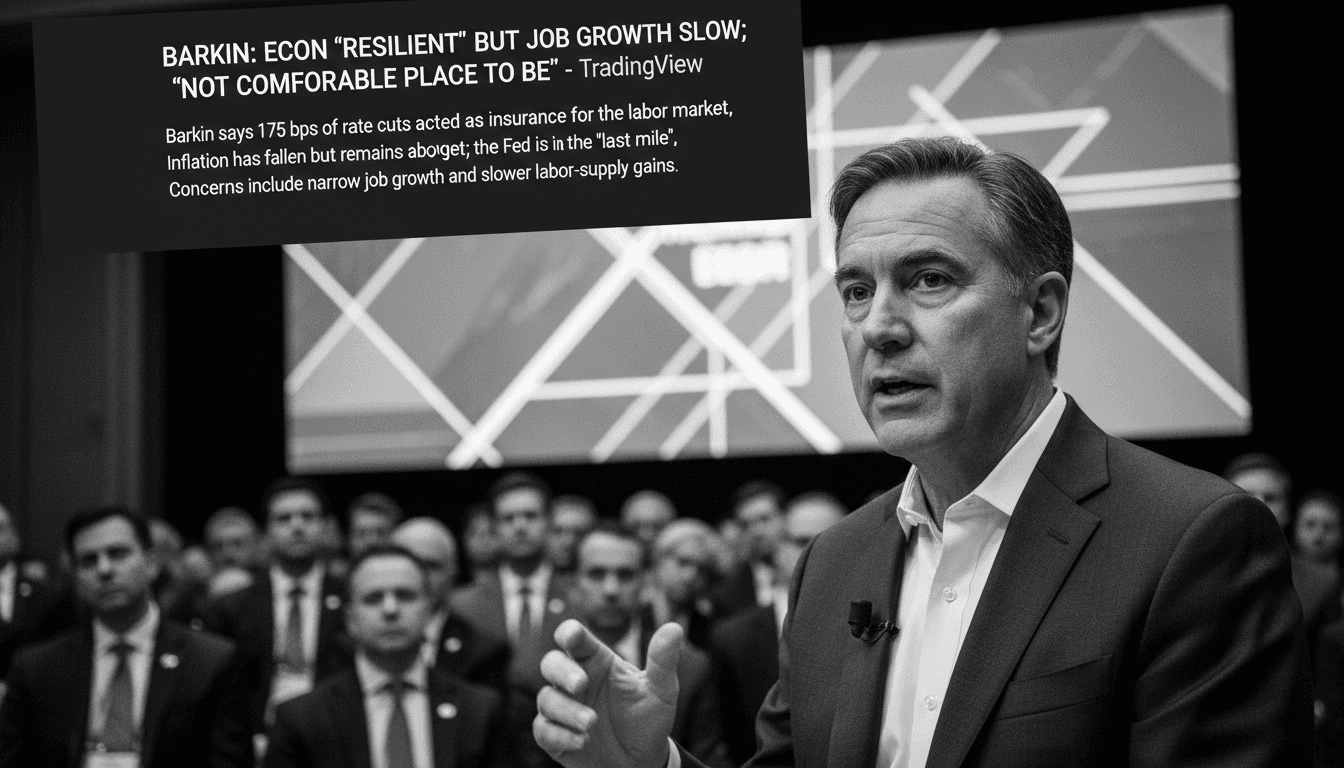
Richmond Fed President Tom Barkin says recent rate cuts have supported jobs while the Fed waits to finish the 'last mile' of disinflation.
• Barkin says 175 bps of rate cuts acted as insurance for the labor market • Inflation has fallen but remains above the 2% target; the Fed is in the 'last mile' • Concerns include narrow job growth and slower labor-supply gains
Federal-reserve caution: Barkin and like-minded policymakers emphasize data dependence — recent cuts helped cushion employment but completing disinflation requires patience and readiness to respond. Market/analyst view: Many market participants welcome signs of resilience but worry that the Fed’s pause could leave policymakers vulnerable if inflation stalls near current levels. Business/household perspective: Firms report steady demand and rising productivity, supporting spending and hiring in specific sectors, but households and smaller employers may feel uneven effects given narrow job gains and longer-term labor-supply constraints.
Richmond Fed President Tom Barkin told an audience in Columbia, S.C., that the Federal Reserve’s cuts of about 175 basis points over the past year and a half have “taken out some insurance” to support the labor market, even as inflation remains above the Fed’s 2% target and the central bank works to complete the so-called “last mile” of disinflation [5][3]. Barkin highlighted the economy’s resilience — citing strong GDP, falling inflation toward 2.8% PCE, low unemployment by historical standards, rising productivity and firms reporting steady demand — while warning that job growth has been narrow and slow, which he described as “not a comfortable place to be.” [5][4][1]. Barkin and coverage of his remarks say the Fed is pausing to await clearer inflation data before further policy moves: cuts to date are framed as insurance for employment while policymakers monitor whether inflation progress continues and risks from policy and structural factors ease [3][5]. He flagged structural concerns that could complicate the final disinflation phase — notably slow labor-supply growth tied to lower net migration and falling fertility, sector-concentrated job gains (mostly in health care and AI-related segments), and the risk that sustained overshoots in inflation could shape future price-setting behavior [5][4]. Commentaries echo Barkin’s cautious optimism, noting the benefits of higher productivity and temporary fiscal/regulatory stimulus but stressing that the “last mile” carries distinct uncertainties for policy [4][3]. In conclusion, Barkin’s message is a balanced assessment: the economy shows resilience and recent rate cuts have eased labor-market risk, but the Fed must guard against getting stuck short of its 2% objective and weigh structural constraints on labor supply when deciding whether to resume easing or tighten again. Markets and policymakers should expect a data-dependent stance — a watchful pause rather than a clear path — until incoming inflation and labor metrics make the final disinflation picture clearer [5][3][4].