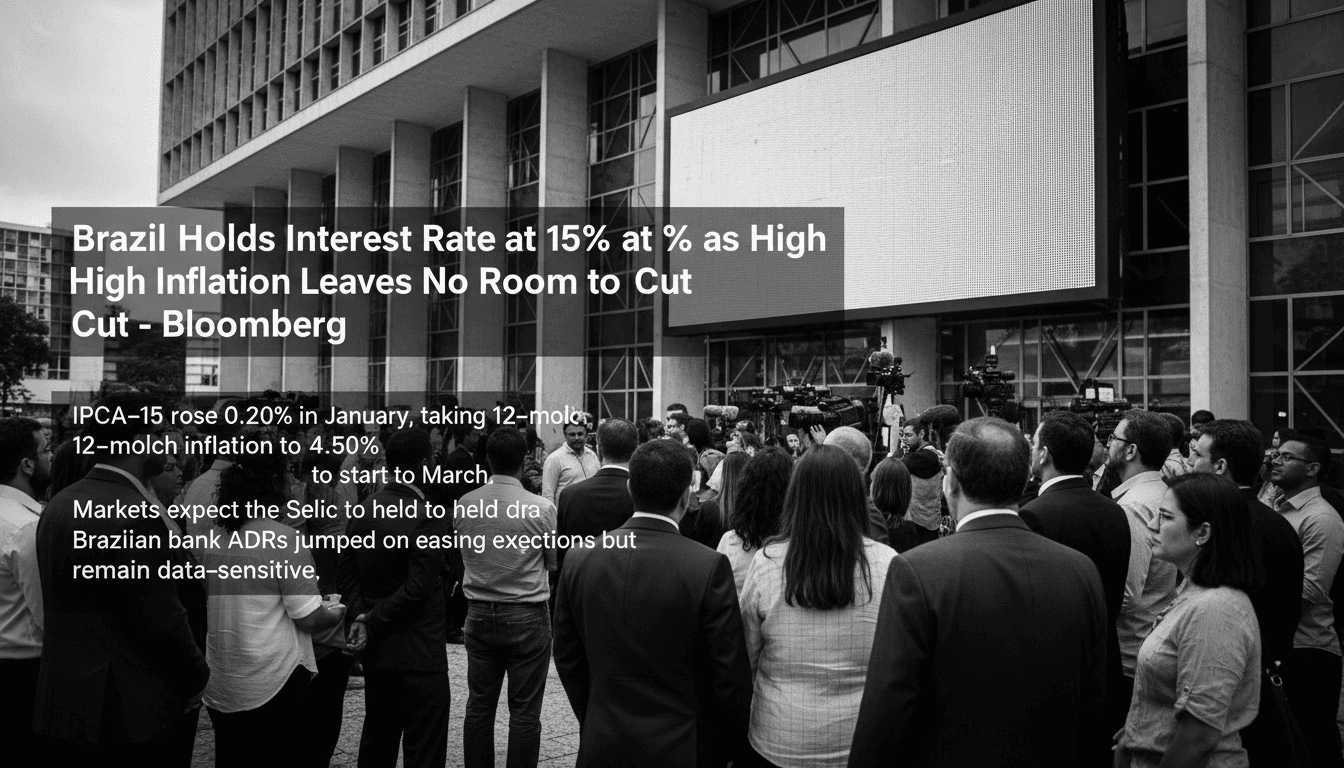
Mid‑month inflation surprise lifts bank shares as markets price a cautious start to rate cuts in March.
• IPCA‑15 rose 0.20% in January, taking 12‑month inflation to 4.50% • Markets expect the Selic to be held at 15% in January and cuts to start in March • Brazilian bank ADRs jumped on easing expectations but remain data‑sensitive
Market/investor perspective: Traders and equity investors are pricing in imminent easing, rewarding bank stocks on the expectation that lower policy rates will stimulate credit and profit growth. Central‑bank/official perspective: Policymakers publicly emphasize data dependence and caution, signalling a likely start to cuts but leaving open the timing and magnitude to avoid feeding inflation risks. Economist/analyst perspective: Forecasters are split on the size and timing of the initial cut (25 bp versus 50 bp) and on the growth outlook, with some seeing a March start as likely while others warn that upside inflation surprises or global rate moves could delay easing.
Brazilian financial markets reacted sharply to mid‑month inflation and fresh central‑bank guidance: Banco Bradesco ADRs rose about 4.5% in New York after the IPCA‑15 mid‑month inflation preview rose 0.20% in January, taking the 12‑month rate to 4.50% — the upper bound of the central bank’s target band — while investors awaited the policy decision. Traders and analysts nevertheless largely expect the central bank to keep the Selic rate on hold at 15% at the January meeting and to begin easing in March, with market commentary noting the move pushed bank ADRs higher amid prospects of lower borrowing costs later in 2026 [1]. Reuters’ economist poll echoed that view: most economists expected a hold at the January meeting and a first cut in March, with opinions split between a 25‑bp or 50‑bp opening reduction; Reuters also noted annual inflation had slowed to about 4.26% at year end, below the 4.5% ceiling, supporting expectations of an easing cycle [2]. Beneath the headline numbers the data mix is uneven and messaging matters. The IPCA‑15 reading masked variation across categories and regions — food‑at‑home prices ticked higher and São Paulo’s sub‑reading dipped — prompting analysts to emphasize that the central bank’s next moves will be data‑dependent and that clear signals for immediate cuts at the January meeting were unlikely, even as March easing is widely priced in by markets [1]. Economists polled by Reuters pointed to a cooling economy and falling inflation expectations as reasons cuts could start in March, but they also flagged growth risks and the potential for inflation to re‑accelerate later in 2026, which leaves room for differing policy paths and makes the pace of cuts uncertain [2]. Market commentators warned that a hawkish tone from Copom or an adverse move in global rates (for example US Treasuries) could quickly reverse the gains in Brazilian financials [1]. In sum, the combination of an IPCA‑15 uptick to the target ceiling and broad polling that anticipates a March easing produced a market reaction that prizes forward guidance but remains sensitive to incoming data and central‑bank language. The dominant scenario priced by investors is a cautious start to rate cuts in March, though the size and speed of the cycle remain contested among economists; bank shares have risen on that expectation but are exposed to downside if inflation dynamics or global risk sentiment shift. Note: I attempted to access the Valor International article URL provided but could not retrieve it; the analysis above is based on the TechStock² report and Reuters coverage as read via syndicated outlets [1][2].