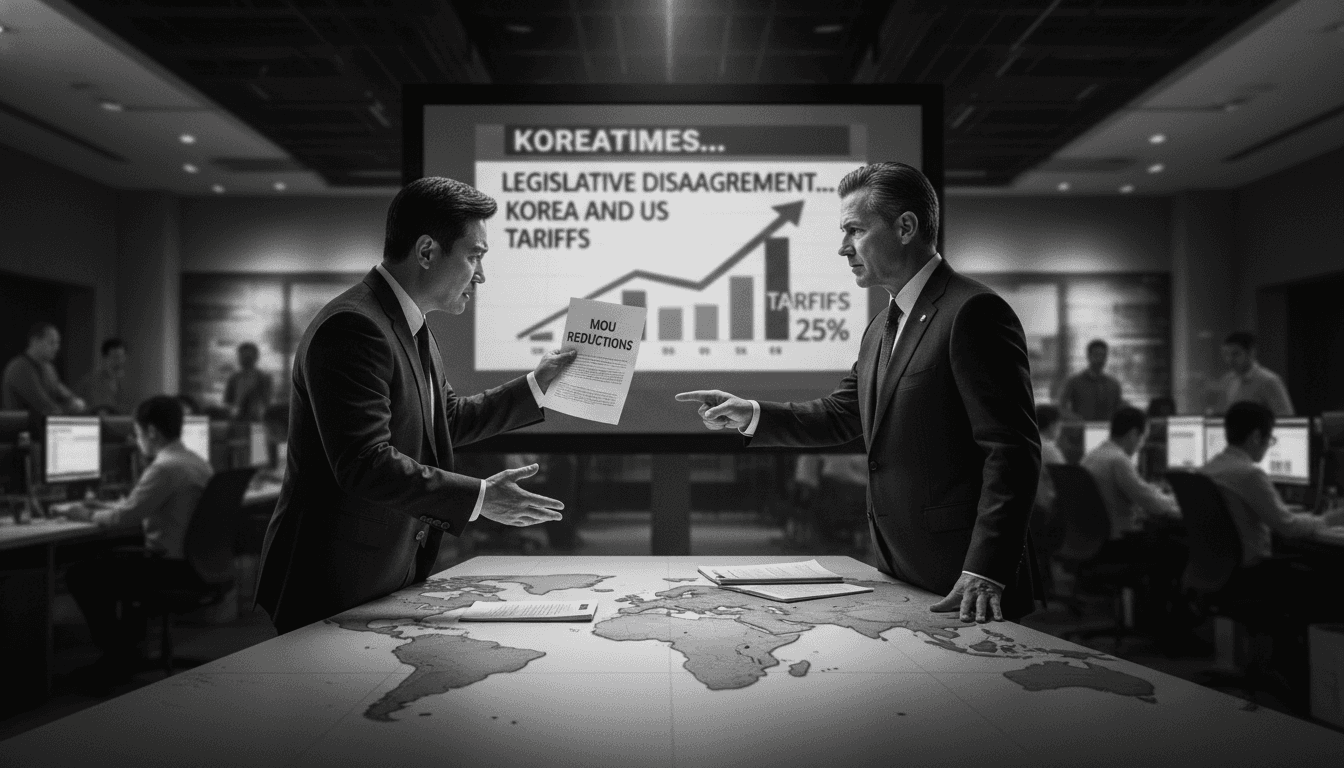
President Trump announced higher US tariffs on South Korean goods, prompting Seoul to reject the claim it violated the bilateral trade understanding and igniting a diplomatic row.
• President announced raising tariffs on South Korean goods from 15% to 25%. • Seoul says MOU reductions were already applied retroactively after bill submission. • Dispute centers on whether Korea’s parliamentary steps were required to trigger tariff changes.
U.S. administration perspective: Emphasizes enforcement of bilateral deals and uses tariff threats or increases as leverage when it judges partners have failed to act. South Korean government perspective: Argues the MOU was implemented according to its terms, that submitting the implementing bill satisfied the agreement’s conditions, and that domestic legislative procedures are being followed in good faith. Business and analyst perspective: Sees the clash as increasing short-term market uncertainty and raising legal questions about unilateral tariff authority and the limits of memorandums versus formal ratification.
U.S. President Donald Trump publicly announced an increase in reciprocal tariffs on South Korean imports — saying he would raise levies from 15% back to 25% and singled out autos, lumber and pharmaceuticals — arguing the Korean legislature has not enacted a trade agreement the two leaders reached last year. This move was communicated publicly on his social posts and reported widely as an immediate executive assertion of tariff policy. [2] Seoul has pushed back, saying the memorandum of understanding (MOU) reached with Washington last year did not tie tariff levels to the completion of Korea’s parliamentary ratification and that, in practice, the U.S. had already applied the tariff reductions retroactively after Korea submitted the implementing bill in late November 2025. South Korean officials also note the implementing bill remains under normal committee review and that the MOU allows Korea flexibility on the timing and scale of planned U.S. investments; Seoul therefore disputes the claim that it has “not lived up” to the deal. Those competing interpretations of the MOU and timing of implementation lie at the heart of the diplomatic clash. [2][1] Note: the BBC link provided in the assignment could not be retrieved by this tool and so its text was not available for review. The result is a fast-escalating policy and messaging dispute: Washington’s unilateral tariff announcement increases near-term economic uncertainty for exporters and raises questions about the U.S. executive branch’s legal authority to impose such measures, while Seoul’s rejection of Washington’s characterisation frames the issue as a disagreement over interpretation and parliamentary procedure rather than a clear breach. Absent rapid bilateral consultations to clarify implementation steps and legal authority, the episode risks further market and diplomatic fallout even as both sides say they remain in contact about next steps. [1][2]
Controversy
The United States (via the President’s announcement) says South Korea has not fulfilled the deal and therefore tariffs will be increased to 25% [2], while South Korean officials say the memorandum of understanding was already being implemented (including retroactive tariff cuts after the implementing bill was filed) and that parliamentary ratification is not required to trigger the agreed tariff levels [1].