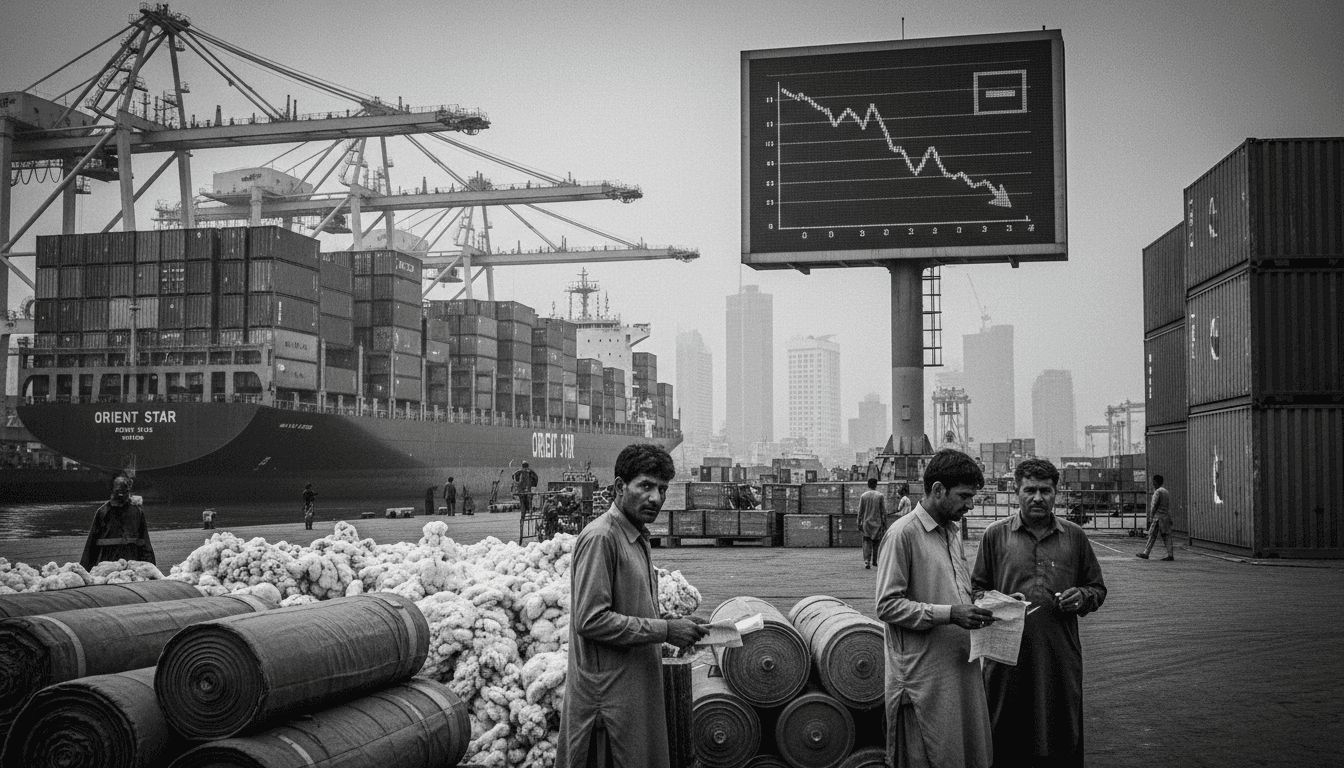
December data show a $244m current-account deficit as imports rebound and export growth softens
• Current-account moved to a $244m deficit in December 2025 • Textile exports rose about 10% YoY to $1.59bn in December • Cumulative July–Dec FY26 current-account deficit reached $1.17bn
Policy continuity and patience: Economists and the World Bank–aligned view that tariff liberalisation and phasing out of discretionary para-tariffs will raise competitiveness but take time to affect export volumes. Business alarm and short-term pressure: Some business leaders and commentators call for urgent action and describe the situation as an "export emergency," emphasising immediate support measures to arrest declines. Data-driven, sectoral view: Analysts focused on balance-of-payments data note textile resilience and remittance inflows but warn that rising imports, financing outflows and uneven sectoral performance necessitate targeted interventions rather than one-size-fits-all measures.
Pakistan’s external position weakened in December 2025, with the State Bank of Pakistan (SBP) reporting a monthly current-account deficit of $244 million after a $98 million surplus in November; cumulative July–December FY26 moved to a $1,174m deficit from a $957m surplus a year earlier. Goods imports rose to $5.74bn while goods exports were $2.75bn; trade in services was also negative (services exports $936m, imports $1.31bn). Workers’ remittances remained a support at $3.59bn, even as the financing account posted a net outflow of $596m and FDI showed a net outflow of $135m. [1][3][4] Sectoral data show mixed signals. Textile exports recorded a near-10% year-on-year increase to $1.59bn in December and accounted for roughly 58% of total exports, with knitwear, ready-made garments and bed wear among the top contributors; still, total exports for December were down year-on-year and goods exports in the first half of FY26 declined to $15.2bn from $16.6bn, widening the trade deficit from $14.5bn to $19.2bn. Policymakers have introduced a National Tariff Policy (2025–2030) that frontloads reductions in average tariffs and phases out discretionary para-tariffs (ACDs and RDs), but analysts say export responses typically lag and depend on policy credibility and continuity. [5][2] Taken together, the numbers point to an external position still heavily dependent on remittances and official financing, vulnerable to swings in imports, investor sentiment and geopolitical disruptions; while textiles show resilience, the headline deterioration underscores the need for consistent reform implementation and targeted action to address trade composition and financing gaps. Observers caution that clarity and continuity in policy will be key to converting tariff reforms into sustained export growth. [1][5][2]
Controversy
Some commentary attributes the fall in headline exports to a drop in rice exports and reduced trade with Afghanistan and Central Asia, arguing these factors drove the export slowdown. [2] However, SBP-sector data cited by other outlets show rice exports rose year-on-year in December and that textile exports grew strongly in the month, suggesting the decline in headline exports is not straightforwardly rice-driven and that sectoral patterns are mixed. [5][1]