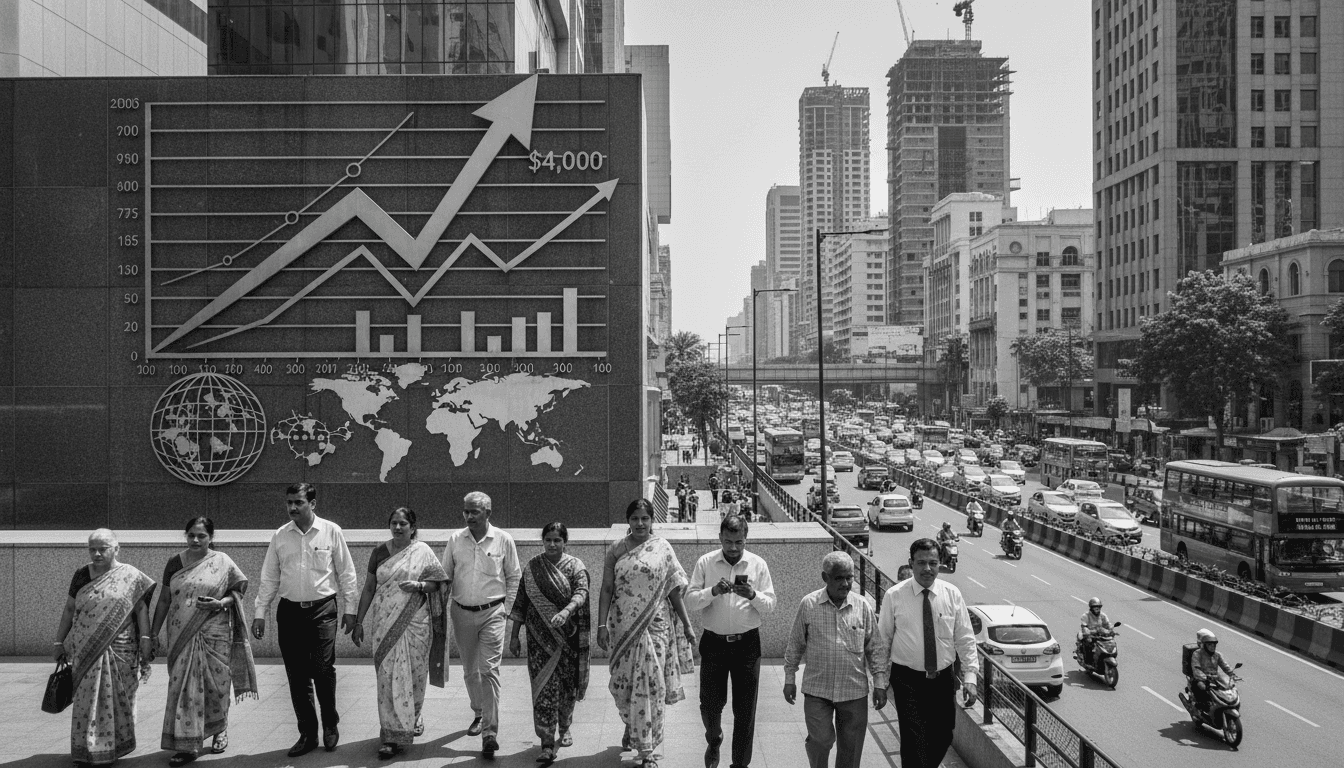
SBI research projects India as the world’s third-largest economy by 2028 and an upper-middle-income country by 2030.
• SBI projects India to be the world’s third-largest economy by about 2028 • Per-capita GNI expected to approach ~$4,000, moving India to upper-middle income by 2030 • Sustained nominal GDP growth (~11.5% in dollar terms) and reforms needed for long-term targets
Official/Research view: SBI Research and coverage present an optimistic, data-driven projection that India can become the third-largest economy by 2028 and reach upper-middle-income status by 2030 if current growth continues and reforms persist. Market/Analyst view: Financial and business reporting emphasises the numeric milestones and the macro assumptions behind them (dollar-term nominal growth, deflators, population trends) and flags that thresholds and exchange-rate effects make targets conditional. Social/Political view: Opinion pieces stress that rising per-capita income and a growing middle class have broader implications for governance, checks and balances, and social expectations—highlighting that economic milestones interact with political and institutional dynamics.
A new SBI Research assessment projects that India will become the world’s third-largest economy by around 2028 and transition to an upper-middle-income country by about 2030, with per-capita GNI moving toward roughly $4,000 and the economy reaching roughly $5 trillion in the coming years. The report also notes India’s improving growth ranking globally and argues that sustained nominal GDP growth in dollar terms of about 11.5% over the long run would be needed to meet high-income targets by 2047. [1][3][4] This outlook is presented against a recent historical trajectory in which per-capita income milestones ($1,000, $2,000, $3,000) were reached in shorter intervals and India’s global rank moved up materially; SBI flags both the achievability and the risks, noting that thresholds for income categories can shift and that assumptions about population growth and price deflators matter for dollar-term targets. The rise of a larger middle class and its political-economic implications are highlighted in commentary elsewhere, which frames economic gains as linked to changes in social expectations, governance and checks and balances in India’s democracy. [1][3][4][2] Taken together, the four sources portray a broadly optimistic but conditional scenario: mainstream reporting and SBI’s analysis see the upper-middle-income and third-largest economy milestones as reachable if strong growth continues and reforms persist, while analysts and opinion pieces emphasize the socioeconomic and institutional adjustments—and the uncertainty around international-dollar thresholds—that will determine whether projected gains translate into sustained improvements in living standards. [1][3][4][2]
Controversy
Sources differ slightly on the income-threshold framing: one report summary describes India hitting about $4,000 per-capita and entering upper-middle-income status on that basis [1], while other contemporaneous accounts of the SBI report cite the World Bank’s upper-middle threshold nearer $4,500 and describe India as approaching—rather than definitively crossing—that boundary by 2030 [3][4].