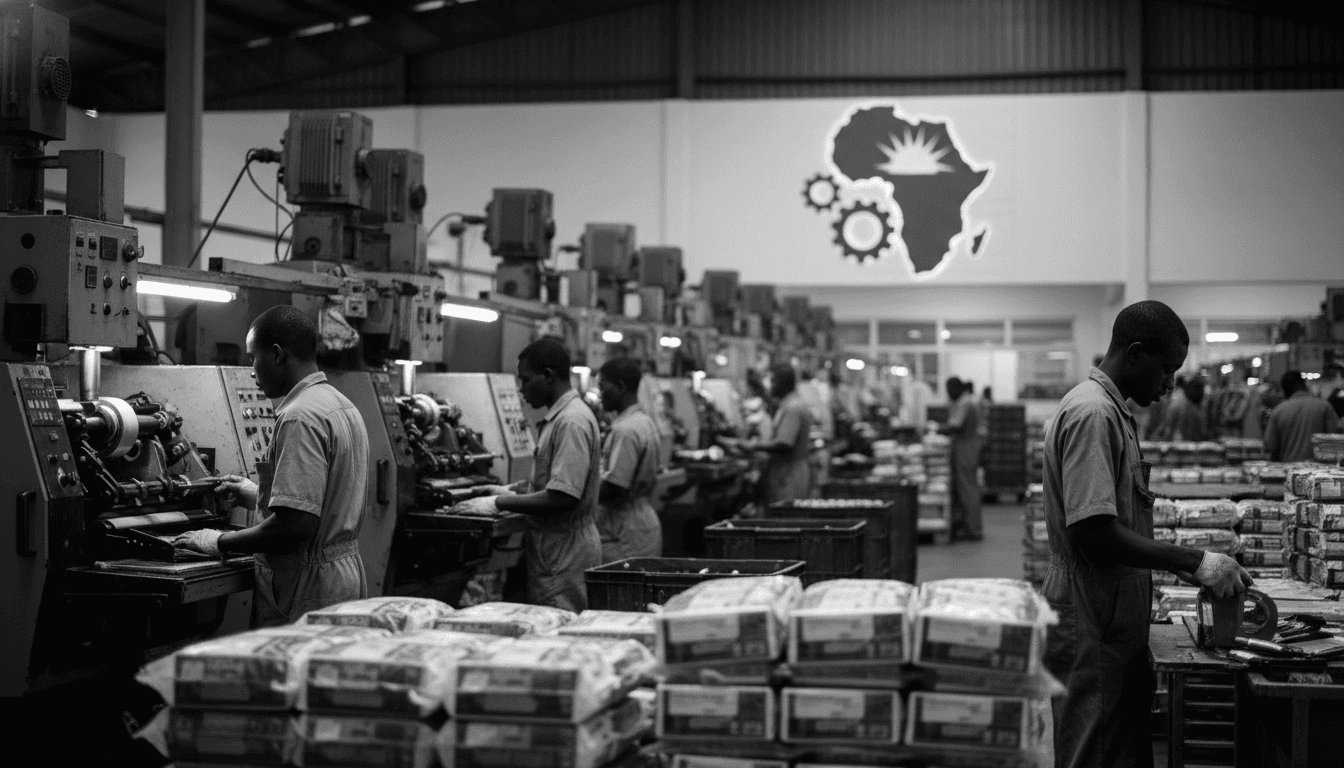
Federal government launches industrialisation policy and urges reduced imports, leveraging public procurement to boost manufacturing.
• Government promotes Nigeria‑First procurement to spur local manufacturing • New industrial policy targets manufacturing share of GDP at 20–25% • Experts call for energy, security and backward integration to enable success
Government/Ministry: Emphasises procurement reform, policy predictability and an implementation committee to convert the Industrialisation Policy into jobs and higher manufacturing contribution to GDP. Manufacturers/Private sector: Stress that predictable rules and steady demand — rather than perfection — are what will enable investment, expansion and job creation. Experts/Analysts: Argue that complementary measures (reliable energy, security in agrarian regions, backward integration, and support for MSMEs and farmers) are required to achieve the policy’s import‑substitution and GDP targets.
The Federal Government has begun promoting a Nigeria‑First approach to procurement and industrialisation, with the Minister of State for Industry urging that the country stop importing goods it can produce and use steady government demand to stimulate local manufacturing, especially in textiles, automotive, medical equipment and furniture [1][2]. A new Nigerian Industrialisation Policy — described by officials as aligned with the president’s eight‑point agenda — sets targets to raise manufacturing’s contribution to GDP to around 20–25 percent and is built on pillars including competitive production, value‑chain deepening, import substitution, MSME‑to‑industry transition, AfCFTA‑era trade competitiveness and stronger institutional governance; an implementation committee has been set up to turn the strategy into measurable outcomes and jobs [3][5]. Independent commentators and experts have urged complementary measures — such as backward integration to source inputs locally, more reliable and affordable energy in industrial hubs, better security in agrarian areas and support for farmers and MSMEs — to ensure the policy reduces import dependence and curbs imported inflation [4]. These announcements are presented as part of a shift from consumption‑driven, discretionary policy toward rule‑based, predictable frameworks that encourage private investment: ministers and industry participants emphasise predictability, procurement reform and coordinated execution as prerequisites for private investors to expand and for value chains to deepen, citing Bangladesh and Vietnam as illustrative models where predictability and focused policy delivered export growth and jobs [1][2][3]. The government has framed the policy launch and planned formal rollout as immediate priorities for 2026, signalling an administrative focus on converting policy into procurement rules and implementation plans [5]. At the same time experts highlight that fiscal, infrastructure and security constraints must be resolved for the stated targets to be realistic and sustained [4]. In sum, media accounts converge on the government’s goal to cut import reliance and scale up manufacturing through a new industrial policy and procurement reforms, while emphasising that success will hinge on predictable rules, execution capacity, infrastructure and rural security [1][3][4][5]. One notable reporting discrepancy across outlets concerns the ministerial name used in coverage: some pieces identify the official as Senator John Owan, while others name him John Enoh, a point that requires clarification from official sources to avoid confusion in public communication [1][2][3][5].
Controversy
Some reports refer to the Minister of State for Industry as Senator John Owan, while others identify the official as John Enoh, creating a factual inconsistency in coverage [1][2][3][5].