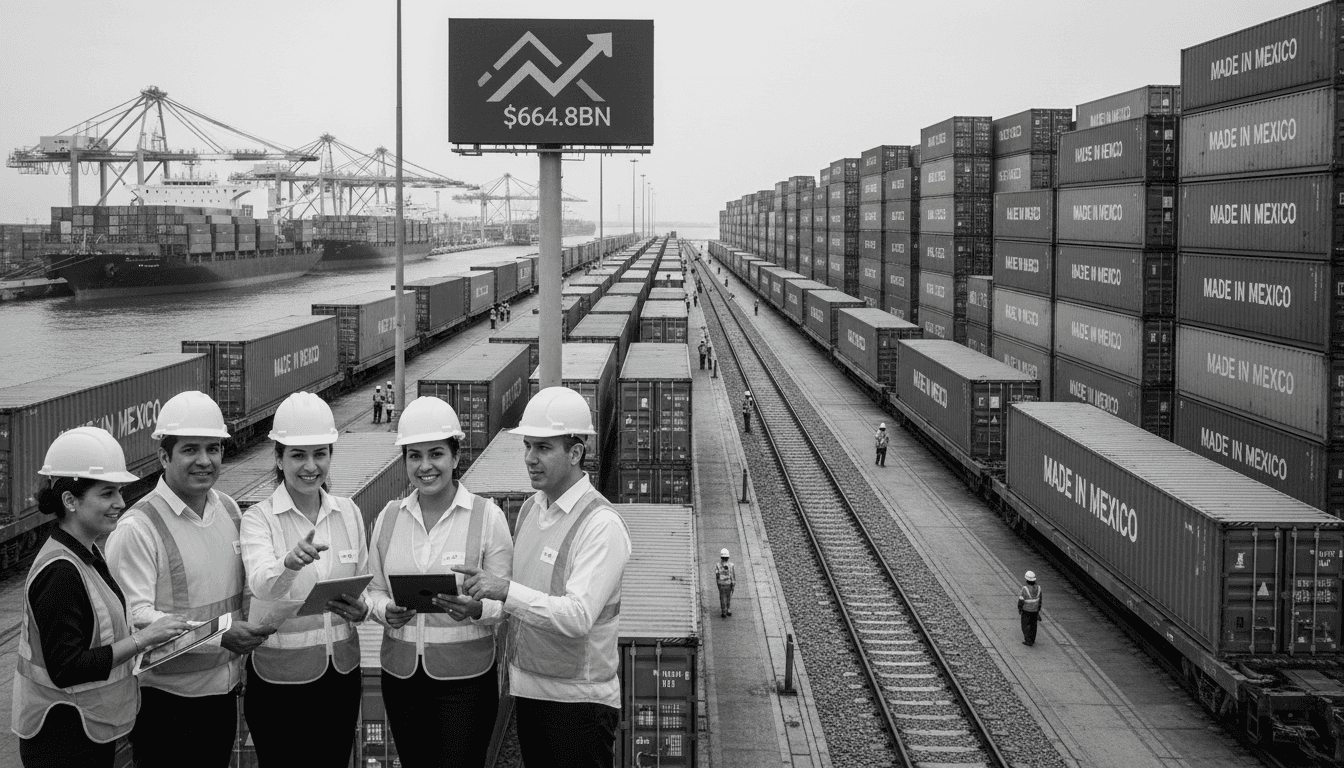
A strong export surge and a December trade surplus helped Mexico avoid a recession in 2025, but weak investment leaves growth fragile.
• Mexico avoided a 2025 recession thanks to a Q4 rebound • Exports topped US$664.8bn in 2025 and powered growth • December posted a US$2.4bn merchandise trade surplus
Government/official framing: Emphasizes exports and social transfers as the stabilizing forces that prevented a recession and highlights near-term upside from stronger trade and consumption. Market and trade analysts: Point to December’s strong export data and the widened trade surplus as evidence that external demand remains a key support, while noting composition risks (non-vehicle manufactured and mining-led growth, weakness in oil exports). Economic policy and academic commentators: Warn that the recovery is fragile because of sharply weaker fixed investment, rising informality and policy uncertainty, and that sustained growth will require a pickup in productive investment and clearer institutional signals.
Preliminary national statistics show Mexico avoided a technical recession in 2025 after growth rebounded in the fourth quarter: quarter-on-quarter GDP rose 0.8% in Q4 and year-on-year Q4 growth was reported at around 1.4–1.6%, while full-year 2025 growth is reported in the 0.5–0.7% range depending on the source. Exports were the main immediate driver — shipments exceeded US$664.8 billion (a 7.6% increase on 2024) with more than 83% destined for the U.S. market — and December alone saw a sharp expansion in merchandise exports that helped produce a US$2.4 billion trade surplus for the month. [1][2][3] Sector data and trade composition help explain the pattern: agriculture and primary activities showed strong gains in Q4 while industry and manufacturing were only modestly higher, and services accelerated modestly; manufacturing’s recovery was uneven. December export growth was concentrated in mining and non-vehicle manufactured goods while vehicle exports broadly stagnated and oil exports tumbled amid domestic refining policies; imports also rose strongly (around mid-teens year-on-year in December), making the monthly surplus partly a function of export strength rather than collapsing imports. Analysts cited in the coverage point to a collapse in public investment, a sharp drop in fixed investment, rising informality and policy uncertainty as underlying constraints on a broader recovery. [1][2][3] The combined picture is one of a trade-led stabilization: stronger exports and a widening December merchandise surplus prevented negative GDP outcomes in 2025, but the recovery looks shallow and dependent on external demand. Persistent weak fixed investment and institutional uncertainty mean growth is fragile and likely contingent on whether investment and domestic demand pick up in 2026; sources note the early-2026 outlook could improve if manufacturing, construction and consumption strengthen (including World Cup–related activity). Policymakers and markets will likely read December’s trade improvement as a positive near-term signal, but structural weaknesses flagged by analysts keep the medium-term outlook cautious. [1][2][3]
Controversy
Reported full-year GDP for 2025 differs across sources: Mexico News Daily cites a 0.7% full-year rise and Q4 q/q +0.8% (with Q4 y/y ~1.4%) [1], while the Argus summary reposted on Forex Factory reports Q4 y/y growth of 1.6% and full-year 2025 growth of about 0.5% [3]. The discrepancy reflects slight differences in preliminary estimates and reporting conventions. [1][3]