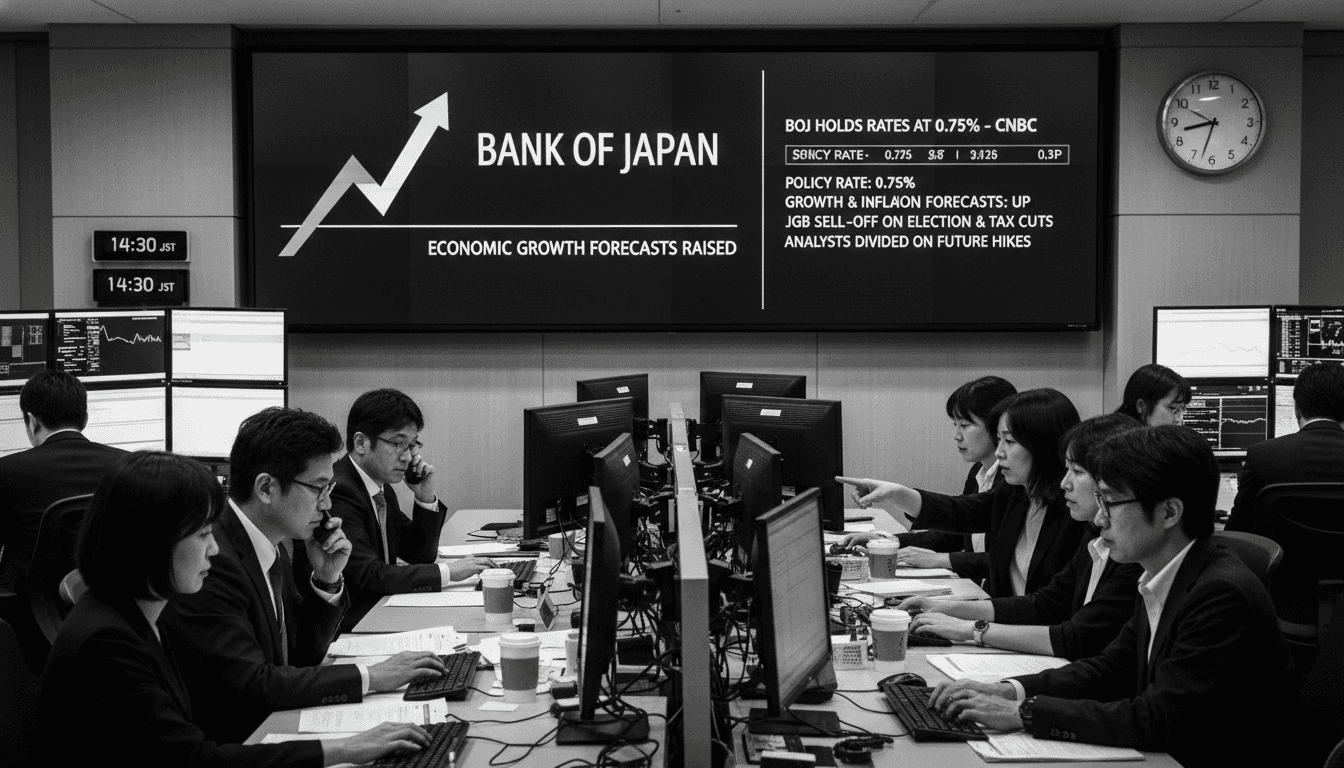
Bank of Japan keeps policy rate at 0.75% as a snap election and proposed fiscal stimulus trigger a sharp rise in government bond yields and market uncertainty.
• BoJ kept policy rate at 0.75% and raised growth and inflation forecasts • Snap election and proposed unfunded tax cuts spurred a sharp JGB sell-off • Analysts disagree on timing of further BoJ hikes; central bank stays data‑dependent
Government/Premier perspective: The prime minister is using a snap election and fiscal stimulus (including a proposed food tax cut) to gain public support and address cost-of-living concerns. Central bank perspective: The BoJ is signaling cautious optimism about recovery and is data-dependent — willing to raise rates as wages and growth solidify but mindful of market stability and timing. Market/investor perspective: Bond investors and some analysts are alarmed by the prospect of large unfunded fiscal measures, which have driven yields sharply higher; equity markets have so far been supported by tech strength but remain sensitive to further policy and yield developments.
The Bank of Japan left its policy rate unchanged at 0.75% following a December increase, while updating its growth and inflation forecasts; markets reacted to the decision with muted equity moves in Japan even as broader Asian tech strength supported regional bourses. Japan’s central bank reiterated that it will raise rates as growth and wages firm, but gave few clues on timing for further hikes. [1][2] The near-term market shock has been driven by Prime Minister Sanae Takaichi’s decision to dissolve the lower house and call a snap election for February 8, and by her government’s proposed unfunded tax cut and large spending package — measures that analysts say prompted a historic sell-off in JGBs (including 40-year yields above 4% and large moves in 30-year yields) and renewed concerns about Japan’s debt dynamics. The political timeline and policy pledges have therefore complicated the BoJ’s task of communicating a hawkish path without stoking further yield volatility. [3][4][2] Looking ahead, market and policy commentary diverge: some analysts and market participants see a need for faster tightening if inflation and wage momentum persist, and the BoJ retains tools such as pausing tapering or emergency bond-buying to calm markets; but macro forecasters at banking groups expect additional hikes to be gradual and not immediate, with the timing dependent on wage negotiations, inflation persistence and currency moves. In short, the BoJ has chosen a cautious, data-dependent approach that leaves room for both further hikes and supportive interventions if market stress continues. [2][4][5]
Controversy
There is a disagreement over how soon the BoJ will tighten further: some market commentators and analysts argue for faster, possibly multiple rate hikes this year in response to inflation and wage momentum, while ING (and similar forecasters) expects further hikes but judges them unlikely to be imminent, pushing the next increase later in 2026. [2][5]