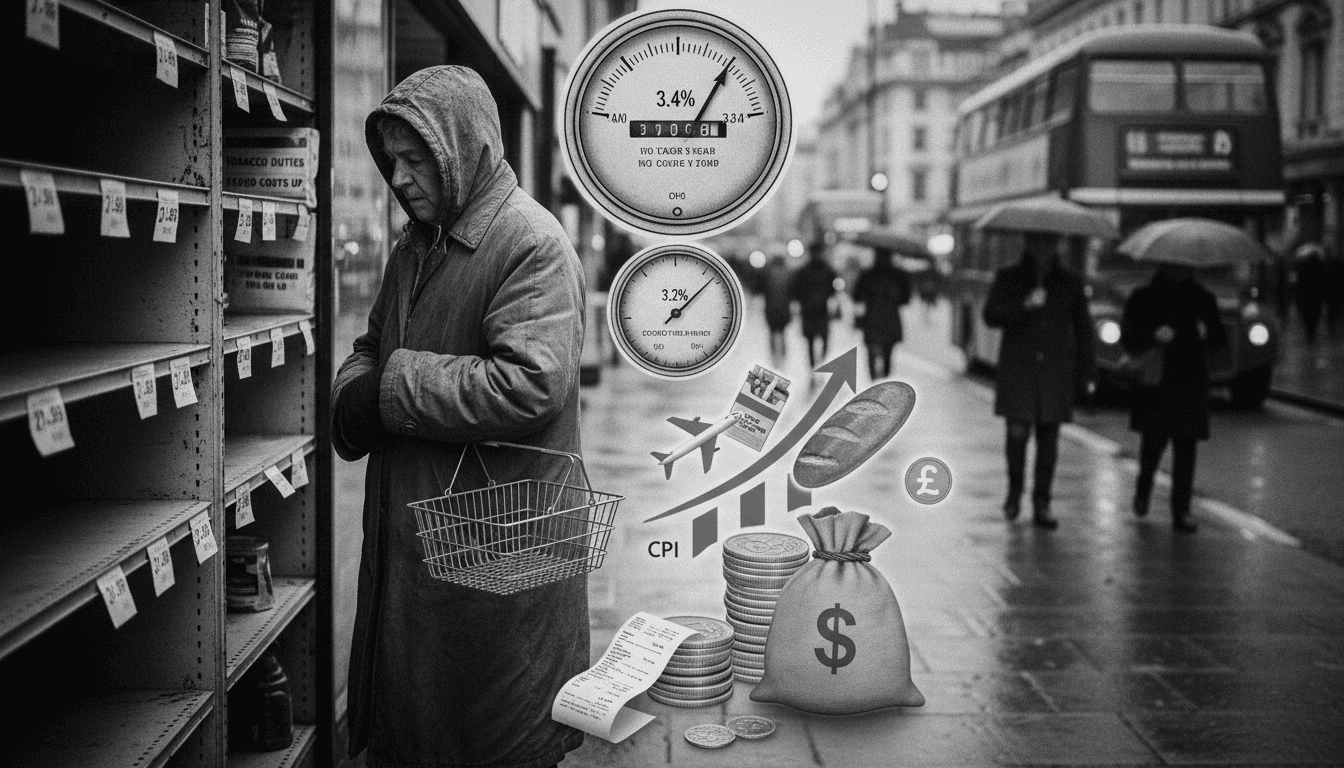
UK headline CPI ticked up in December, driven by food, airfares and higher tobacco duties, but authorities expect inflation to fall toward 2% by spring.
• ONS: UK CPI rose to 3.4% in December from 3.2% in November • Main drivers: higher tobacco duties, rising airfares and food costs • BoE cut Bank Rate to 3.75% and expects inflation near 2% by Q2
Central bank: The Bank of England positions itself for gradual easing — it cut Bank Rate in December and emphasises that further cuts depend on clear, sustained disinflation and labour‑market slack. Market analysts: Some forecasters (and market pricing) interpret December’s uptick as temporary and expect one or two rate cuts in 2026 if inflation falls toward 2% as projected; others highlight risks from persistent services and wage pressures. Public and political: Households and policymakers remain focused on cost‑of‑living pressures — higher food and tobacco costs raise political sensitivity even as authorities point to falling inflation later in 2026.
The Office for National Statistics reported that UK consumer price inflation (CPI) rose to 3.4% in the 12 months to December 2025, up from 3.2% in November, with a monthly increase of 0.4%; food and non‑alcoholic beverages inflation rose to 4.5%, alcohol and tobacco made a large upward contribution, and transport (notably airfares) also pushed the monthly rise. These headline and component figures are shown in the ONS statistical bulletin. [3][1] The Bank of England’s December minutes record that the Monetary Policy Committee voted 5–4 to reduce Bank Rate to 3.75%, and the Bank noted that staff and some members expect headline inflation to fall back toward the 2% target by 2026 Q2 as last year’s large utility and administered price increases drop out of the annual comparison and Budget measures lower salient price effects; the Bank stressed that any further easing of policy will be gradual and conditional on labour‑market and wage developments. Market commentary and Reuters reporting framed the December CPI rise as slightly above expectations while reiterating guidance that inflation should fall to near target in April–May, and that markets are pricing possible rate cuts later in 2026. [5][3][2] Market and analyst notes add nuance: ING’s briefing (published on Seeking Alpha) highlights that core services inflation remains elevated (around 4% by the ING calculation) and that food inflation, though higher in December, is below some Bank forecasts — implying February policy moves were unlikely to be affected and that a clearer disinflationary picture should emerge by April, supporting the Bank’s conditional easing path. Trading and data services track the same recent uptick while showing the broader downtrend in inflation through 2026 if disinflation continues. Overall, the data point to a short, modest headline rebound driven by a few volatile and policy‑driven components, with official forecasters and markets expecting a return toward 2% by mid‑2026, leaving policy decisions hinging on incoming wage and services inflation evidence. [1][4][5][3][2]