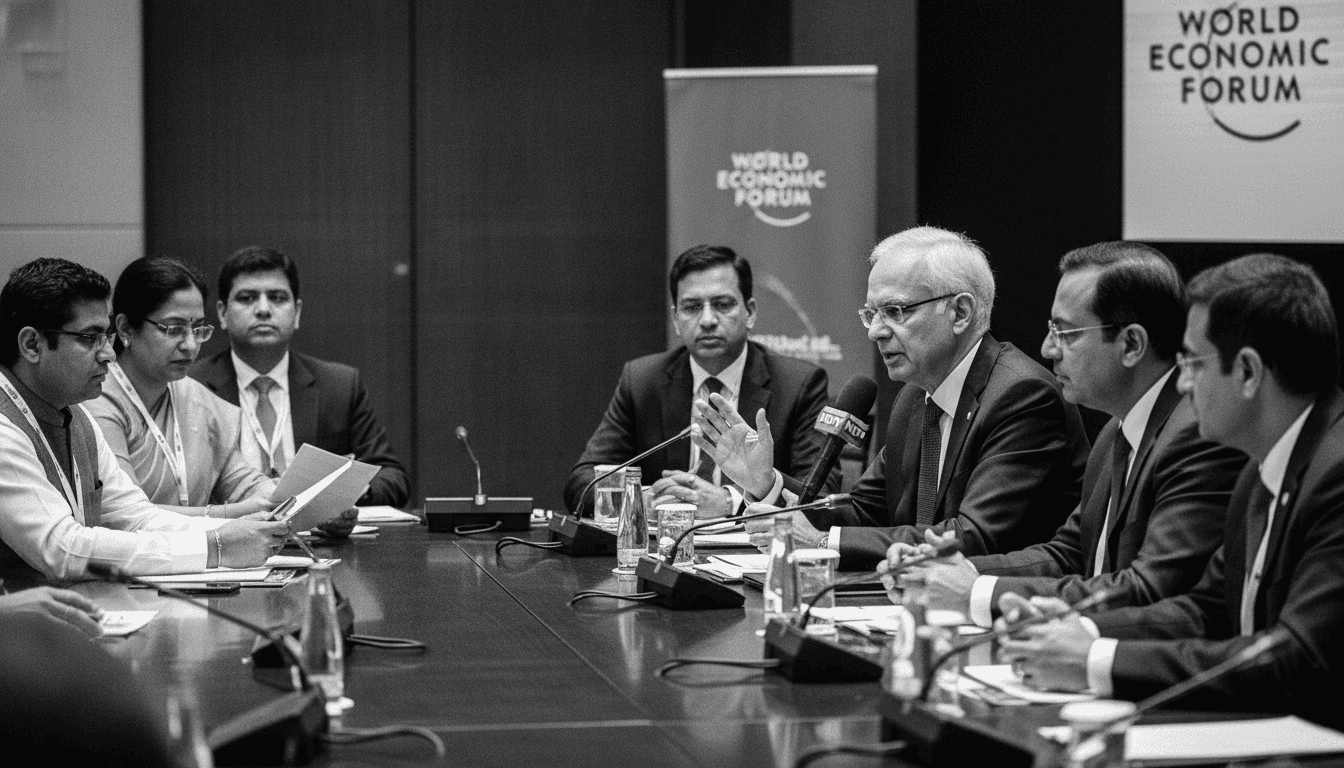
State delegations, young entrepreneurs and WEF leaders spotlight India’s investment push and growth potential at Davos.
• Gujarat delegation led by Deputy CM Harsh Sanghavi held 58 high‑level meetings to woo investors • Uttar Pradesh delegation pitched a USD 1 trillion economy vision at Davos • WEF chief said India could contribute about 20% of global growth this year
State governments/business delegation perspective: Subnational leaders (Gujarat, UP and GIFT City representatives) view Davos as a platform to secure investment, showcase reform agendas and attract technology and financial‑services partnerships. WEF/international perspective: WEF leadership frames India as a major driver of near‑term global growth and stresses the importance of trade deals and technology governance, while flagging geopolitical and AI‑related risks that could shape outcomes. Youth and civil‑society perspective: Young Indian entrepreneurs and Global Shapers at Davos emphasize innovation, social entrepreneurship and the role of talent in converting macroeconomic potential into inclusive growth.
At the World Economic Forum annual meeting in Davos (Jan 19–23, 2026), multiple Indian subnational and institutional delegations actively pitched investment and growth plans. Gujarat’s delegation, led by Deputy Chief Minister Harsh Sanghavi, is undertaking some 58 high‑level one‑to‑one meetings to promote a ‘Developed Gujarat @2047’ roadmap and to attract investment across advanced manufacturing, semiconductors, renewables, pharmaceuticals, shipping‑logistics and aerospace; a GIFT City delegation and IFSCA officials are separately pursuing international financial services, fintech and sustainable finance ties. [1] A Uttar Pradesh delegation led by Finance Minister Suresh Kumar Khanna arrived to position the state as a global investment destination and to showcase a USD 1 trillion‑economy vision at the forum, which this year features record government participation and the WEF’s “A Spirit of Dialogue” programme of panels and live‑streamed sessions. [4] Alongside government and corporate delegates, younger Indian participants — including WEF Global Shapers such as Ishan Pratap Singh and other entrepreneurs — were highlighted as part of India’s representation in Davos. [3] At the same time, WEF president Borge Brende told NDTV he expects India to be the fastest‑growing large economy this year and suggested India could account for roughly 20% of global growth, while noting that trade agreements and technological adoption (and associated risks) will shape outcomes. [5] This mix of state delegations, subnational economic pitches, youth representation and WEF leadership comments illustrates a two‑track India strategy at Davos: attract foreign direct investment and global partnerships at the state and city level (finance, manufacturing, technology and infrastructure), while leveraging a narrative of rapid reforms and outsized macroeconomic contribution to global growth. The real test will be post‑Davos follow‑through — whether meetings convert into concrete investments, partnerships or policy shifts — amid broader geopolitical and technological headwinds discussed at the forum. [1][4][5]